

Your Donor Hair Is a Finite Resource: Why Hair Restoration Needs a Long-Term Budget
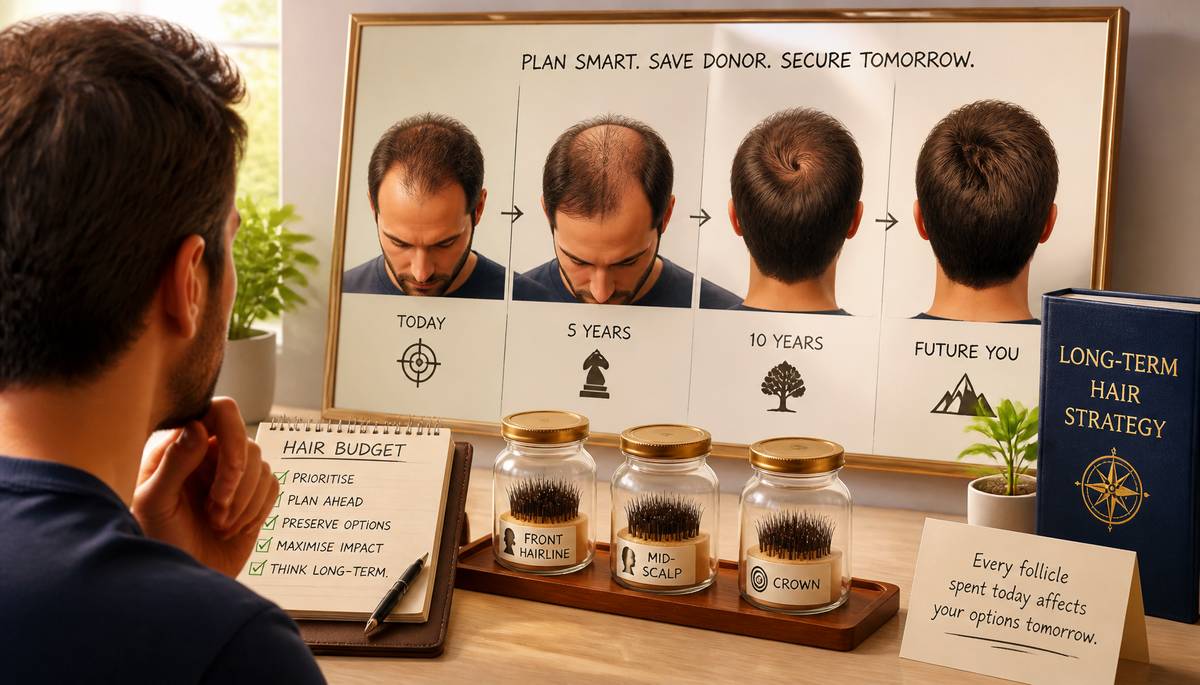 Hair follicles are remarkably good at many things, but multiplying themselves on command is not one of them. That matters enormously when considering hair restoration, because the donor area at the back and sides of the scalp contains a limited number of follicles that can be moved safely. Once a graft has been transplanted, it cannot simply be replaced with a fresh one from an imaginary follicle warehouse.
This makes donor hair less like an unlimited building material and more like a long-term budget. The aim is not necessarily to spend as much of it as possible during the first procedure. Good planning means deciding where those grafts will have the greatest visual impact while leaving enough flexibility for whatever your hair decides to do in the future. Hair, unfortunately, has never shown much respect for five-year plans.
Why More Grafts Are Not Automatically Better
It is easy to assume that a larger transplant must produce a better result. Sometimes a substantial number of grafts really is appropriate, but the number alone tells you surprisingly little. Where those follicles are placed, how densely they are distributed and how naturally they blend with existing hair can matter just as much.Using thousands of grafts to create extremely high density in one area may look impressive initially, but it can become problematic if surrounding natural hair continues to thin. A patient could eventually have a wonderfully dense island of transplanted hair surrounded by areas that now need attention too. At that point, yesterday's enthusiastic graft spending may suddenly look rather extravagant.
A carefully designed restoration therefore considers future hair loss as well as present hair loss. This is particularly important for younger people whose eventual pattern of thinning may not yet be obvious.
Think Beyond the Hairline
The front of the scalp understandably receives enormous attention. It frames the face, appears in photographs and is difficult to ignore when looking in a mirror. Yet designing a hairline without considering what might happen behind it can create problems later.An extremely low, dense hairline can consume a large proportion of available donor grafts. If thinning subsequently progresses through the mid-scalp or crown, fewer follicles remain available to restore those areas. A slightly more conservative hairline may therefore provide a stronger long-term result, even if it initially sounds less exciting than recreating the hairstyle you had while buying CDs in 1996.
The Crown Can Be a Hungry Customer
The crown presents another challenge because its natural spiral pattern can require a surprisingly large number of grafts to create the appearance of substantial coverage. Attempting maximum density there may consume donor hair that could eventually be needed elsewhere. For someone with extensive or progressive hair loss, spreading resources intelligently can be more valuable than trying to make every square centimetre equally dense.This does not mean the crown should be ignored. It means priorities matter. Hair restoration is partly an exercise in creating visual density rather than simply replacing every follicle that disappeared. Strategic placement, appropriate styling and differences in hair calibre can all influence how much coverage a given number of grafts appears to provide.
Future You Gets a Say Too
Hair loss is often progressive. Transplanted follicles taken from suitable donor areas may retain greater resistance to the processes responsible for common pattern hair loss, but the original hair surrounding them can continue thinning. Consequently, a restoration plan that looks sensible at 30 should ideally still offer workable options at 40, 50 and beyond.This is why assessing the donor area involves more than counting hairs. Characteristics such as density, follicular grouping, hair thickness, scalp condition and the likely stability of the donor region can influence what is realistically available. The potential progression of hair loss elsewhere also needs consideration.
There is another important limitation: removing too many follicles can make the donor area itself look depleted. Moving hair around the scalp is redistribution, not creation. Somewhere has to supply every graft, and the back of the head will eventually notice if it is being treated like an all-you-can-eat buffet.
Build a Hair Budget Before Spending It
Long-term planning means asking questions beyond "How many grafts can I have?" More useful questions include how many grafts can safely be harvested, which areas deserve priority, how future thinning might change the picture and whether additional procedures could reasonably be performed later.Age, family history and the existing pattern of hair loss can all contribute to that discussion. Non-surgical approaches may also form part of a broader strategy for suitable individuals, particularly when preserving existing hair could reduce the demand placed on donor reserves.
Importantly, conservative planning does not necessarily mean accepting a weak cosmetic result. It means using a finite resource efficiently. A carefully positioned graft can contribute far more to the overall appearance than its tiny size might suggest.
Make Every Follicle Count
Hair restoration is unusual because today's decision can influence what remains possible many years later. There is no reliable way to order another ten thousand permanent donor follicles if the original supply has already been exhausted.That makes restraint a potentially valuable part of treatment planning. The objective is not to win a competition for the largest graft count. It is to create a natural-looking result while preserving enough donor capacity to respond intelligently if hair loss continues. Sometimes the smartest hair investment is simply keeping a few follicles in the bank.
Article kindly provided by drpeterthomas.co.uk
Latest Articles
- Could Your Home's Plumbing Be Affecting Your Health Without You Realising?
- Toothache: When to Monitor, Call Soon or Seek Urgent Dental Care
- Your Donor Hair Is a Finite Resource: Why Hair Restoration Needs a Long-Term Budget
- Why Your Fitness Routine Needs More Easy Days, Not More Hard Ones
- The Hidden Hair Loss Triggers Most People Never Think About
- The Mouth-Body Connection Most People Ignore
- The Psychology of Texture in Wellness Photography
- When DIY Beauty Goes Too Far: Treatments Better Left to Professionals
- The Hidden Link Between Jaw Tension and Everyday Headaches
- Sleep Timing Shapes Hormones More Than You Think
- How Subconscious Habits Affect Your Skin Health
- Fragrance Fatigue Is Real: How Smaller Bottles Help Your Nose Stay Sharp
- Traveling with a Baby: Smart Packing Strategies for Modern Parents
- How Oral Health Quietly Influences Energy Sleep and Long Term Well Being
- How Emotions Affect Your Skin
- Everyday Walks as Brain Games for Your Dog
- How Light Weights Can Build Serious Strength
- Missing Dental Supplies and What They're Really Telling You
- Rethinking Early Intervention Strategies for Childhood Behavior Support
- Keep Going: The Brain Science of Turning Setbacks Into Momentum
- Nutrition and Dietetics
- Exercise and Fitness
- Meditation and Yoga
- Mental Health
- Women's Health
- Men's Health
- Children's Health
- Senior Health
- Heart Health
- Sleep Health
- Skin Health
- Eye Health
- Dental Health
- Pain Management
- Addiction and Recovery
- Sexual and Reproductive Health
- Alternative Medicine
- Chronic Conditions
- Weight Management
- Occupational Health and Safety
- Public Health
- General Health Tips
- Beauty